The Breath Toolkit: How it Can Rewire Your Nervous System
Explore the top breathwork techniques—from Buteyko nasal breathing to Box Breathing and 4-7-8—and learn how to use them to manage stress, sleep better, and optimize health.
Your breath is a remote control for your nervous system. Whether you are prepping for a high-stakes presentation, recovering from a intense workout, or struggling with racing thoughts at midnight, changing the rate and depth of your breath can immediately alter your state of mind.
However, with so many breathing exercises popular today, it can be hard to know which technique to use and when.
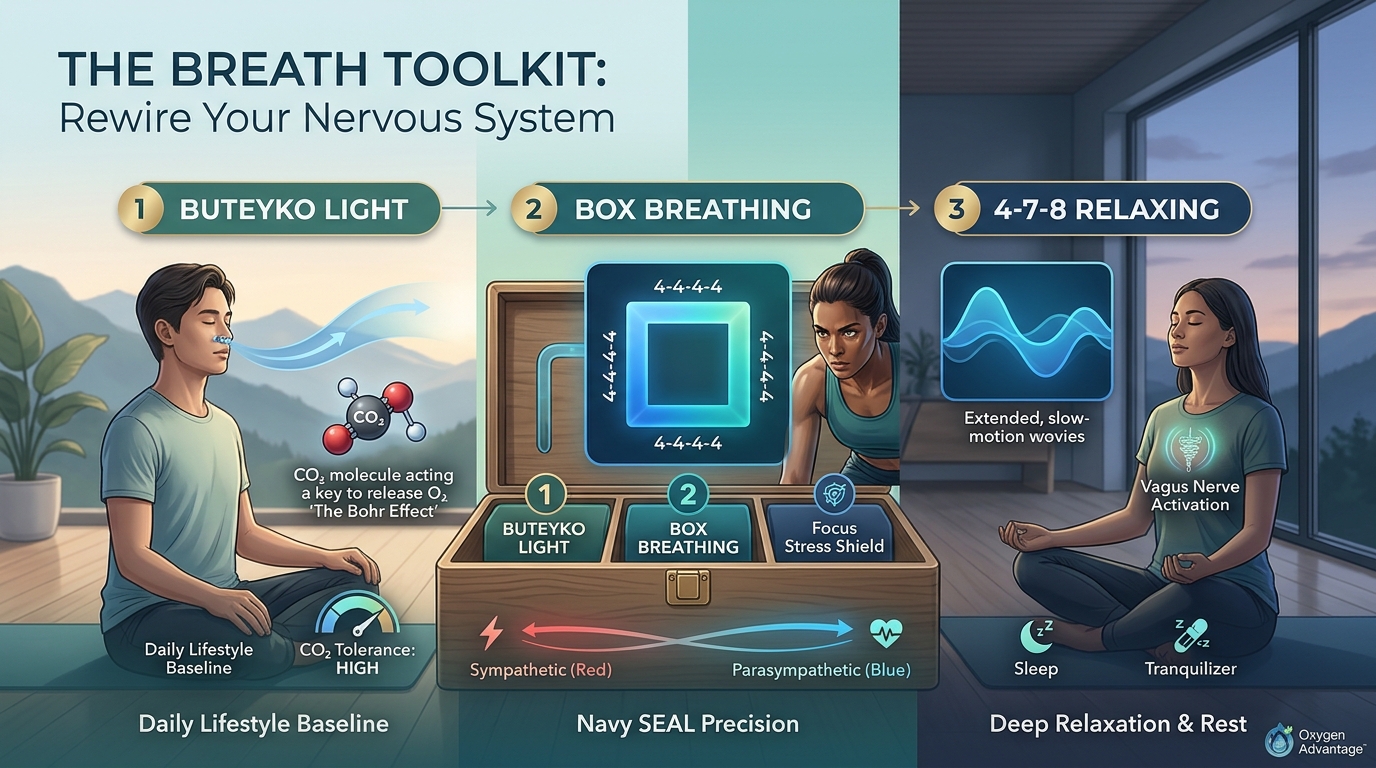
Here is a breakdown of three of the most powerful functional breathing styles—Buteyko Light Breathing, Box Breathing, and 4-7-8 Breathing—and how you can use them as your daily toolkit.
1. Buteyko Light Breathing: The Daily Lifestyle Foundation
While many breathing patterns are used as temporary stress-relief tools, Buteyko Breathing is a way of life. Originating from Ukrainian doctor Konstantin Buteyko and popularized in high-performance athletics by Patrick McKeown (The Oxygen Advantage), this method focuses on functional baseline breathing.
- How it Works: You sit upright, close your mouth, and slow down your breath until you feel a mild, comfortable “air hunger.”
- Why it Works: It retrains your chemo-receptors to tolerate higher levels of Carbon Dioxide (CO2). According to the Bohr Effect, adequate CO2 allows oxygen to release from blood cells into your vital organs and brain.
- When to Use: All day, every day—during work, walk, rest, and sleep.
2. Box Breathing: The Focus & Stress Shield
Also known as Square Breathing, this technique is famously utilized by Navy SEALs, first responders, and elite athletes to maintain calm composure under extreme physiological stress.
- The Pattern:
- Inhale through your nose for 4 seconds
- Hold your breath for 4 seconds
- Exhale smoothly through your nose for 4 seconds
- Hold empty for 4 seconds
- Why it Works: The equal 1:1:1:1 tempo regulates heart rate variability (HRV) and balances the sympathetic (action) and parasympathetic (calm) branches of your nervous system.
- When to Use: Before a big event, during high-stress moments at work, or when you need sharp, calm focus.
3. The 4-7-8 Technique: The Natural Tranquilizer
Popularized by Dr. Andrew Weil, the 4-7-8 technique is a fast-acting pattern designed to pull your body out of “fight-or-flight” mode and shift it straight into deep relaxation.
- The Pattern:
- Inhale quietly through your nose for 4 seconds
- Hold your breath for 7 seconds
- Exhale completely (or through a soft nasal sigh) for 8 seconds
- Why it Works: Extending the exhale longer than the inhale lowers your heart rate by activating the vagus nerve. The prolonged hold allows $\text{CO}_2$ levels to stabilize and calms central nervous system arousal.
- When to Use: Right before sleep, during an anxiety surge, or when recovering from an intense workout.
How These Techniques Compare
| Feature | Buteyko Light Breathing | Box Breathing (4-4-4-4) | Relaxing 4-7-8 |
| Primary Goal | Retrain baseline CO2 tolerance & oxygen delivery | Reset focus & mitigate immediate stress | Deep relaxation & sleep onset |
| Best For | Overall health, energy, daily stamina | Peak workplace & athletic performance | Insomnia, anxiety relief, evening unwind |
| Cadence | Quiet, subtle, light nasal flow | Equal 4-stage box tempo | Extended 8-second exhale |
Take Control of Your Physiology Today
Understanding breathwork is step one—incorporating it into your daily life with proper biomechanics and pacing is where real transformation happens.
Whether you want to eliminate habitual mouth breathing, boost your BOLT score, or master stress-relief protocols, personalised breath coaching provides the structure and guidance you need.
Book a discovery session today to learn how customised functional breath training can elevate your health, energy, and mental clarity!