
Nasal Breathing: Unlocking Peak Performance & Health
Discover how functional nasal breathing, Buteyko principles, can transform your stamina, focus, and overall health.
Have you ever considered that the way you take your next breath could dictate your energy levels, sleep quality, and athletic recovery?
In a world that tells us to “take a deep breath” whenever we feel stressed or exhausted, we’ve inadvertently conditioned ourselves to over-breathe. We take large, gasping breaths through open mouths, operating under the false assumption that more air equals more oxygen for our bodies.
The physiological reality is quite the opposite: how you breathe matters far more than how much air you take in.
The Misconception About Deep Breathing
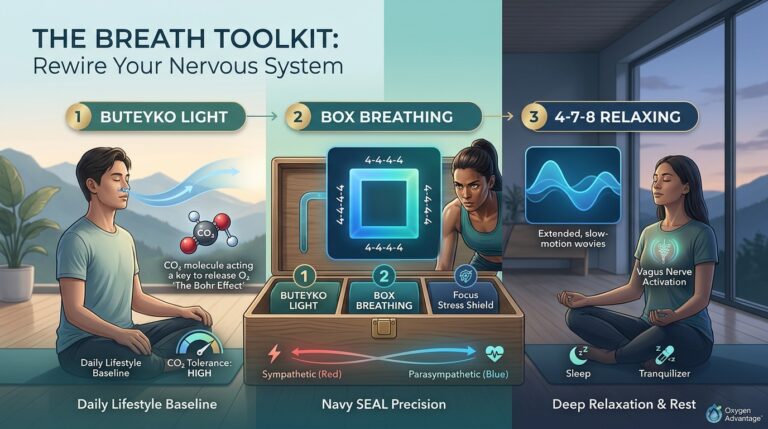
When you over-breathe or breathe through your mouth, you blow off too much carbon dioxide ($\text{CO}_2$). Most people view $\text{CO}_2$ as merely a toxic waste gas, but in human physiology, it acts as the vital key that unlocks oxygen delivery to your tissues.
This fundamental scientific principle is known as the Bohr Effect:
- Oxygen Transport: Hemoglobin in your red blood cells carries oxygen throughout your bloodstream.
- Oxygen Release: Oxygen only releases from hemoglobin into your muscles, organs, and brain when sufficient $\text{CO}_2$ is present in the blood.
- The Danger of Mouth Breathing: Chronic mouth breathing strips $\text{CO}_2$ levels, causing blood vessels to constrict and hemoglobin to hold onto oxygen rather than releasing it where it’s needed most.
The Buteyko Method & The Oxygen Advantage
Pioneered by Dr. Konstantin Buteyko and expanded globally by Patrick McKeown through The Oxygen Advantage, functional breathwork focuses on three core pillars:
1. Strict Nasal Breathing
Your nose is specifically built for breathing. It filters, warms, and humidifies incoming air while generating Nitric Oxide ($\text{NO}$)—a potent vasodilator that opens blood vessels, improves gas exchange, and destroys airborne pathogens before they hit your lungs.
2. Light, Slow, and Deep (Diaphragmatic) Breathing
By softening your breath until you feel a gentle, tolerable hunger for air, you retrain your brain’s respiratory center to tolerate higher normal levels of $\text{CO}_2$. Over time, this improves oxygen delivery to every cell in your body.
3. Simulating High-Altitude Training
Through structured breath-hold exercises, you can safely trigger natural physiological adaptations—including increased red blood cell count and boosted aerobic capacity—without having to travel to the mountains.
Key Benefits of Functional Breathwork
- Enhanced Athletic Stamina: Delay lactic acid buildup and reduce breathless exertion during workouts.
- Deeper, Restful Sleep: Eliminate nighttime mouth dryness, snore less, and wake up feeling genuinely restored.
- Sharper Focus & Reduced Anxiety: Shift your autonomic nervous system from “fight-or-flight” into “rest-and-digest.”
Measure Your Functional Breathing Baseline
How healthy are your breathing habits right now? You can easily test your baseline using the Body Oxygen Level Test (BOLT):
- Take a quiet, normal breath in through your nose, then let a normal breath out.
- Pinch your nose closed and start a timer.
- Stop the timer at the first definite urge to breathe (or the first involuntary movement of your breathing muscles).
- BOLT Score under 20 seconds: Indicates over-breathing, lower $\text{CO}_2$ tolerance, and potential for energy crashes or sleep disturbances.
- BOLT Score of 40 seconds: The benchmark for optimal breathing, efficiency, and physical resilience.
Elevate Your Life with Functional Breath Coaching
Breathing is the only autonomic function you can consciously control. By shifting from hyperventilation to quiet, efficient nasal breathing, you optimize your body’s internal chemistry.
Ready to boost your energy, recovery, and performance? Contact me today to schedule your personalized 1-on-1 functional breathwork session and unlock your true physiological potential.